
The London Design Festival celebrates 25 years in 2027. The festival has had its share of bumps along the way to that quarter-century mark. By 2019, visitors had swelled to 600,000. As with other shows, it recovered from the pandemic years. Then came a search for identity, as shows like 3 Days of Design in Copenhagen started to sizzle. Most recently, there was chatter about unseating LDF with a much more buzzed-about, fewer-moving-parts venue in Clerkenwell, an area that boasts a high percentage of architects.
But LDF 2026 was the strongest in years, thanks largely to craft and independent makers. Mega-installations still dot the city, but they’ve been dialed down. Now, you can find significant stops for more than 1.1 million exhibition visits in each of 11 districts — with Soho the newest.
It has become a tale of two Londons, both strong. On the west is the more posh, pristine Mayfair, Kensington and Chelsea, where the Design Centre lives. On the east is Shoreditch, formerly known as the Shoreditch Design Triangle.
Once a rough, seedy area, Shoreditch has embraced its grit, along with its lively street art and now-trendy cafes and coffee houses. It has become a new epicenter — some might even argue, its heart. Shoreditch Design Week ran for only three of the nine days.
Here’s an important kicker: promotional materials say 10,000 visitors are targeted, and 62% of the audience are working architects and designers. Beyond the four hubs are 60 showrooms and galleries, spotlighting independent makers, materials, artisanal creation and sustainability.
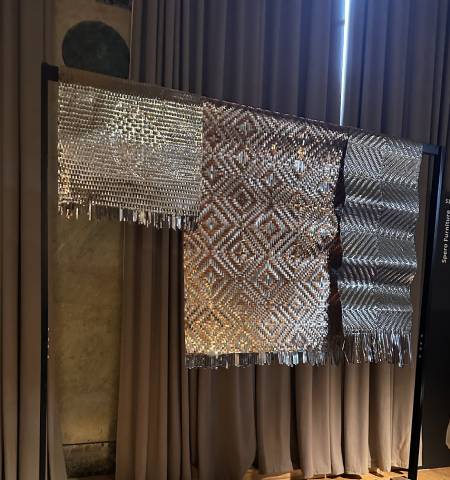
Starting with the House of Icon in the Town Hall, known brands like Thonet, which showed fashion designer Jil Sander’s take on the classic Marcel Breuer chair, brushed shoulders with global crafts brands like the Indian Artisanal Abode, which displayed textile-like hand-woven metals. At the industrial Kachette building, New Designers Selects (NSD) showcased technique. A leather-clad stool called The Comet by Studio Marsa featured a flame edge with a hand-painted border and hand stitching. It was also a playful interpretation of sitting in the hot seat.
Neurospaces at Protein Studios, co-sponsored in part by OnOffice magazine, which staged Design + Work there, invited those seeking the latest in neuroaesthetics, acoustics and building materials — both in product and dialogue. In addition, Steelcase opened its doors to a refurbished showroom in Clerkenwell that underscored wellness and a hybrid working lab.
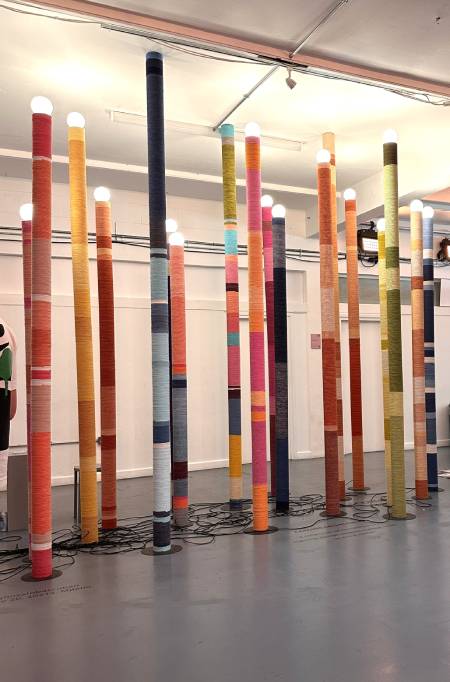
Attendance at SDW was robust. One reason: Material Matters moved from the OXO Wharf. In the past, there was some eye-rolling about heading all the way to the east end for events. Not now. MM is an anchor, promoting biomaterials like mycelium and products made from waste. Like the skinny totem lights by Chilean designer Gonzaldo Bascuñan, made from discarded fashion fabrics, one of the show’s hits.
Isola is also in that mix. So you have that Milan-transplant plus a little bit of the Alcova (Salone) vibe. The very staging in the Isola space told an innovative materials story. Half walls were constructed from reduced-carbon, cement-based bricks with a proprietary rotational system from Mark McKie (McKie’s Rotational Bricks).
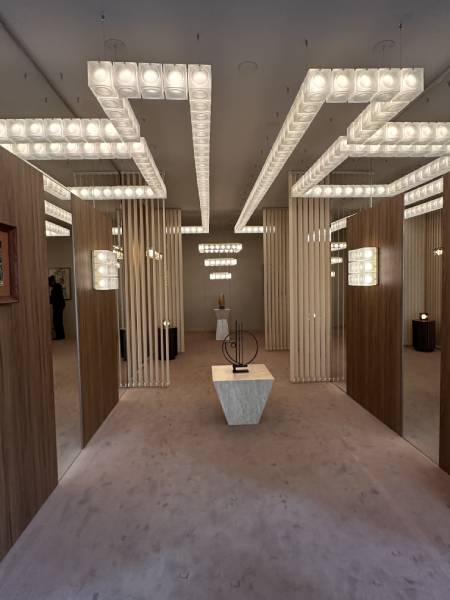
In addition, well-known design labels like lighting brand Lee Broom and Christopher Farr, who teamed up with the Max Radford Gallery, both opened their studio doors with installations that made many design publications’ top 10 lists.
The Soho Design District, another space long celebrated for its rebellious counterculture, drew attendees to a range of installations. Labyrinth Dreams, a collab between Bethan Laura Wood and Canadian glass brand Bocci, featured a spherical, portable light in a new color — Purple 14p. The designer drew inspiration from the 1986 David Bowie film Labyrinth for her architectural scenography.
In the Ham Yard Hotel Courtyard, also in Soho, GUDU (Studyo Akdogan) debuted jagged-shaped but smooth-finished sculptural avant-garde art furniture. The artist drew inspiration from primitive man, survival instinct and hunting tools.
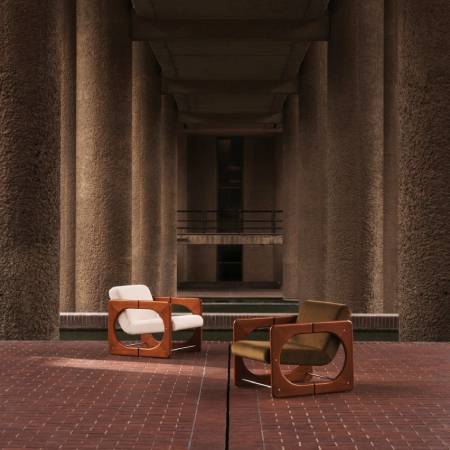
Brutalism was central to the Made x Barbican collection, 23 pieces of furniture, lighting and housewares that pair the online interiors brand Made.com with London’s iconic Barbican Estate. The teams researched original 1960s floor plans and brought them to life with bold geometric carpets and warm, functional furniture. The palette features mid-century tones including moss green, deep rust orange, ochre, burgundy and dusty blues, right on trend, in woven fabrics paired with ash and chrome accents.
The results were imaginative for a challenge by Stancha, AKA Scottish designers Harvey Everson and Findlay MacDonald, put to 10 contemporary designers. The directive: Rethink the hanging basket as sculptural contemporary art. The pieces, shown at the Hackney studio of fashion concept store Awaykin, used diverse materials including laser-cut steel, dangling industrial chains, elaborate 3D-printed cups and caramelized, melted polystyrene waste.
SCP, a name synonymous with shaping British design culture, traded a 40-year history in Shoreditch for new digs in a much larger five-story space in Clerkenwell. The shop became known for pairing functional everyday housewares with experimental, high-end furniture, bringing to the fore now established names like Jasper Morrison, Tom Dixon and Matthew Hilton. Most recently, Faye Toogood gave her chubby Gummy chair a new, rad bright yellow Pierre Frey wool bouclé cover—one of their featured brands: Shore Studios, with an indoor-outdoor collection created with nautical ropes.
On the other side of town, at Focus/26 at Chelsea Harbor, a luxury interiors audience enjoyed some introductions not seen at Salone. The new Design Emporium Collective launched with established names like Bert Frank with its Sablier collection, oversized hourglass-shaped lighting. Naomi Paul, who has long epitomized an independent spirit, continued her tactile explorations with lighting, with her newest hand-crocheted creations.
The mix at The Lavery in the Brompton Design District was diverse; for example, a trio of marble pieces from Kelly Wearsler x Arco made a statement on a landing. Studio Iron presented an extensive and diverse group of artists working in metal, including beaded chainmail. Our Parlor, hosted by Ncheta Collective, highlighted the importance of community and tradition. Designer Zoe Chnonso Ene reimagined a Nigerian parlor game called Ncho in a wood container carved with what looks like fused balls; inside are glass fragments instead of traditional seeds, beautiful on a coffee table, but also as a wall hanging with proprietary hardware.
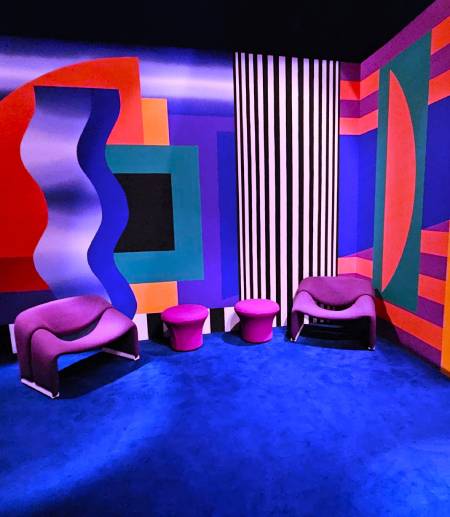
Fumi Gallery in Mayfair continued to push the envelope with edgy interpretations across a range of materials. Its standout exhibition, After School, featured the work of students from the Royal College of Art. Japan House, an outstanding Kensington retailer whose presentation and labels are museum-like, staged its first powerful photography exhibition. Long-time attendees also routinely head over to the artsy Sketch, a popular restaurant/bar destination in an 18th-century townhouse, to see its newest lobby do-over. It did not disappoint. French designer Camile Walala took cues from Memphis to create riotous geometry also inspired by South African Ndebele wall painting and the Op Art of Victor Vasarely for the smashing entry.
Always part of the mix is the Victoria & Albert Museum. The undeniable influence of Japanese craft on home and office design shone through in the Craft x Tech Tokai Project. Six masters from that region were paired with six global designers to translate ancient practice into cutting-edge contemporary product. Bethan Laura Wood leaned into shibori and made it her own with fabric light sculptures in a bright palette. Canadian industrial designer David Caon created a modular ceramic console and lamp in the distinctive green glaze from Mino Yaki Ceramics.
Craft also informed a supersized installation that called attention to the pangolin, the most trafficked animal in the world. Some might remember early associations with Covid-19 genesis theories, never proven. But The Pangolin Shield by Studio Saar and Atelier One is a metaphor for ecological vulnerability and wildlife protection. The creative armored shell, mounted on a bamboo frame, was stunning with its almost iridescent blue and green panels. The glossy finish and colors come from plastic and tarps Indian farmers use as rain shields to protect palms, emulating the animal’s scales. The panels themselves are from traditional Indian police riot shields.
Another outstanding attraction at night: St. Paul’s Cathedral. Ukrainian designer Mykola Kabluka, creative director and founder of Expolight, mixed sound with light on the façade in an immersive light sculpture called The Point of Unity.
Throughout London, there was energy with the celebration of craft, the creative, the unique, seemingly intentionally poking at so many AI threats at every turn. It seems to be an undercurrent at design shows today. Add a good narrative, a highly personal touch from the makers, and perhaps a little humor.
London retains its allure, according to LDF director/co-founder Ben Evans, in part because of a “high profile made by the layers of design stories that the Festival is home to.”
Meanwhile, on its website, touting the next celebratory year, London boldly claims the title of “design capital of the world,” reinforcing the festival’s broader ambition. Stay tuned.