
Earlier this year during Chicago Design Week, I had the privilege of moderating a wonderful panel with Upali Nanda, Susan Magsamen and Margaret Tarampi, titled “Neuroaesthetics, Neuroarchitecture & Intentional Spaces.” We talked about neuroaesthetics, neuroarchitecture, neuro spatial design, sensory experience and how emerging neuroscience research can help us design environments that better support human flourishing. It was an insightful conversation, and one that left me wanting to learn more. So, when I sat down with Upali for an interview a few weeks later, I thought we were continuing that conversation. We did start there, but we also went much deeper.
What started as an exploration of neuroscience and design quickly expanded into a much bigger conversation about human experience, perception, the role of place, design research, interdisciplinary collaboration, agency, innovation and ultimately, impact. And that felt especially timely as Upali was recently recognized with the 2026 IIDA ICON Award for her extraordinary contributions to the profession. The more we talked, the more I realized that these seemingly different topics were not different topics at all. They were pieces of the same question: How can design better understand its power, and use it to make a difference?
Curiosity as a Way of Working
Upali’s own journey helps explain why she sees the connections so naturally. She entered architecture in India because she was fascinated by its unique combination of art and science. But early in architecture school, she realized that she designed and experienced space differently from the way she was being taught to represent it. “My concepts were always visualized in section and typically I would sketch a person and then I would build around them,” she told me. “The way in which I wanted to represent space, it was always tactile, it was always sensorial.” That curiosity led her to study human perception, phenomenology and eventually toward neuroscience. During that learning process, she even spent six months working at a school for children with visual impairments because she wanted to understand how space might be conceived without relying primarily on vision.
Listening to her describe this, I was impressed by how consistently curiosity has shaped her career. She described herself as having been “stubbornly curious,” someone who gets interested in a question and then follows it down the rabbit hole. Curiosity is often treated as a personality trait, but in Upali’s story, it feels more like a professional discipline.
Upali said her research did not begin because she wanted to become a researcher. It began because research opened new questions about design: Could space be dynamic rather than static? Responsive rather than rigid? Could understanding perception change what we conceive? That distinction is important for her. Evidence-based design research is not simply about proving what we already believe, but it is about opening possibilities. She recalled asking herself: “Are we just trying to prove things because we believed them, or are you trying to find things out? Are you investigating, or are you proving? Are you exploring, or are you conforming?” I think that is a question our profession needs to keep asking.
From “Why” to “Where”
One of the ideas Upali shared is her observation that we spend enormous energy thinking about what goes into our bodies, but remarkably little thinking about where our bodies go into. She first articulated the idea at the American Heart Association conference, where she was the only architect in the room. Listening to increasingly precise conversations about nutrition, diet, pharmaceuticals and health, she suddenly saw the contrast: “We are so mindful about what we consume, but we are mindless about what we put our bodies into.”
The built environment, she explained, is largely invisible to people outside our profession. Just like the air around us does, it becomes a background and we don’t always recognize it as a lever for health, cognition, behavior or well-being, even though the evidence continues to grow. We need to shift the conversation and be mindful about where you are putting your body into, and what the environment is doing for the body and the brain. We need to ask not only why, but where. She calls it the “five wheres.”
Where do I want to have a meaningful conversation with my teammate? Where do I want to connect with the broader community? Where do I want to focus and hear myself think? Where might I find a sense of cognitive clarity as I figure out my equation with AI? When we get into everybody asking this question, “Where is it happening and how does that where feel,” that is like an emotional prototyping of the future, a place-based intelligence that lets people see the potential of the designed world around them. A public awareness of what design can do.
For someone who spends much of my own professional life thinking about human experience and the relationship between people and place, this resonated deeply with me. We often talk about experience as though it is something separate from the physical environment. But experience happens somewhere. Our bodies are somewhere. Our senses are responding to something in a physical space. The “where” matters.
Research as a Design Responsibility
Our conversation eventually returned to research, and here Upali became especially direct. “If you believe design can make a difference, and you believe that we can link design to outcomes, then not only is design research necessary, it is irresponsible to do design without research.”
I couldn’t agree more. It is a powerful statement, particularly in a profession where research is sometimes treated as an added layer rather than part of the design process itself. Upali does not suggest that every project needs an academic research study. Instead, she argues that designers need to develop research as muscle and should be trained properly. Sometimes the right approach is quantitative research. Sometimes it is qualitative, observation, ethnography or experience mapping. Sometimes a question warrants deeper scientific investigation. The real skill is knowing what question to ask, when you need to learn, how deeply you need to go and when you need someone else to help you get there. “Understanding the why and how people will use your space is your biggest weapon as a designer,” she said.
While explaining the importance of neuroscience in understanding the why and the relationship between people and place, Upali also cautioned us about the growing number of “neuro” labels appearing across the industry. She calls it “neuro-washing,” similar to the concept of “green-washing.” To her, terminology matters less. “What matters,” she said, “is anchoring on the art and science of being human and learning how to link design to outcomes.” It means studying the intersection, interaction, and the environment around them at all scales, that are appropriate to the question at hand. “There is a component of how our mind works and how environments shape our brains and vice versa, that was invisible to us, that has now become visible. That is the opportunity,” she added.
She also reminds designers to remain humble, and “never apologize for your ability to craft a meaningful question.” We don’t need to become neuroscientists, but we all need to become better at asking meaningful questions. We have to work together with those who have the expertise to investigate deeply through coalition and partnership to create impact that change lives. “If we could find more joy in working together and sharing successes and failures versus competing, we would go a lot further,” she said. I think that may be one of the most valuable lessons for our industry.
Standing at the intersection
Her successful career wearing many hats has given her the lens to leverage philanthropy and nonprofit, industry and practice, as well as academia. As our conversation unfolded, I noticed that her career path continues to be a Venn diagram, with her standing at the intersection of many different disciplines. Upali agreed, “Maybe that’s the story of my life, finding myself standing in the middle of Venn diagrams that I didn’t see until I was standing right there.”
That line made me smile, as I found myself recognizing something familiar in my own career. I have often described my career as an intersection between science and design, research and strategy and education and practice. I have always been drawn to the spaces between disciplines, the places where different kinds of knowledge overlap. The intersection was not necessarily part of some grand plan. Upali’s career was full of curiosity, pivots, unexpected turns and opportunities that led to somewhere that wasn’t planned. But looking back, those intersections became the strength. And that intersection and people who can bridge different disciplines are increasingly what our industry needs. “Especially now, intersections are everywhere, and we should absolutely embrace it,” she said.
Upali describes the ecosystem as “pillars and bridges.” She said, “We need people who go deeply into particular areas of knowledge, but we also need people who can connect those areas and understand when to go deep, when to bridge, and who else needs to be part of the conversation. That connective tissue of professionals and that diversity of thinking is really important.” Her own experience across practice, research, nonprofit leadership and academia has given her that connective view. It is also why her current work reaches beyond the traditional boundaries of architecture and interior design.
Design as a Strategy for Changing the World
Upali explained the important shift in her thinking about design: She no longer believes we should simply think strategically about design, but we should think of design itself as a strategy for changing the world. To do that, she believes designers need to move both upstream and downstream. “We have to go upstream to change the conversation around design,” she said. “Then we have to go downstream to prove the impact that design has.” And that starts with understanding what design actually does. When asked about the innovation in our industry, she shared her personal definition of innovation: “the shortest and most beautiful path to impact.” Rather than chasing innovation as another industry buzzword, she wants us to ask more fundamental questions: “What can design do, and where can it do it? When and where can we get the most impact from it?”
This feels especially important now. Climate change, AI, loneliness, mental health challenges and other disruptions are not isolated problems. They are interconnected human problems, and the environments we create are part of those systems. Upali sees this complexity not simply as a challenge, but as an opportunity. “What gives me the most hope,” she told me, “is that we are looking up now and seeing that this is a system design problem. That we are a node in a system, and we can’t ignore the other parts of the system if we want to make a difference.”
That perspective brings us back to the intersections that have defined so much of her career. Design does not have to solve every problem on its own. But it can help us see relationships that are otherwise difficult to see. It can translate research into experience, connect disciplines, make invisible influences more visible and give people a different way of understanding the environments around them. And when we understand that power more clearly, we also begin to reclaim our agency, as a responsibility to use design more thoughtfully and intentionally.
Where Design Can Make the Most Difference
I came away from my conversation with Upali thinking that the future of our profession is not about adding another specialty, another label or another methodology to our toolbox. It is about becoming more curious about people, more rigorous about what we know, more humble about what we don’t and more intentional about the experiences we create. As our conversation came into full circle, I found myself returning to the question that had surfaced throughout our discussion: not simply what we design, but where it happens, how it feels and what it does for the people who experience it.
Upali’s career is a reminder that some of the most meaningful ideas emerge at the intersections: between disciplines, between research and practice, between people and place and between what we know and what we can discover with our curiosity. That is what makes her hopeful about our design industry’s future. “This is the moment for design to come into its own, for design to take agency and claim agency, and understand that in this complex system.” She leaves us with a question that feels bigger than any one project, profession or discipline:
“Where can I make the most difference and who can I make it with?”
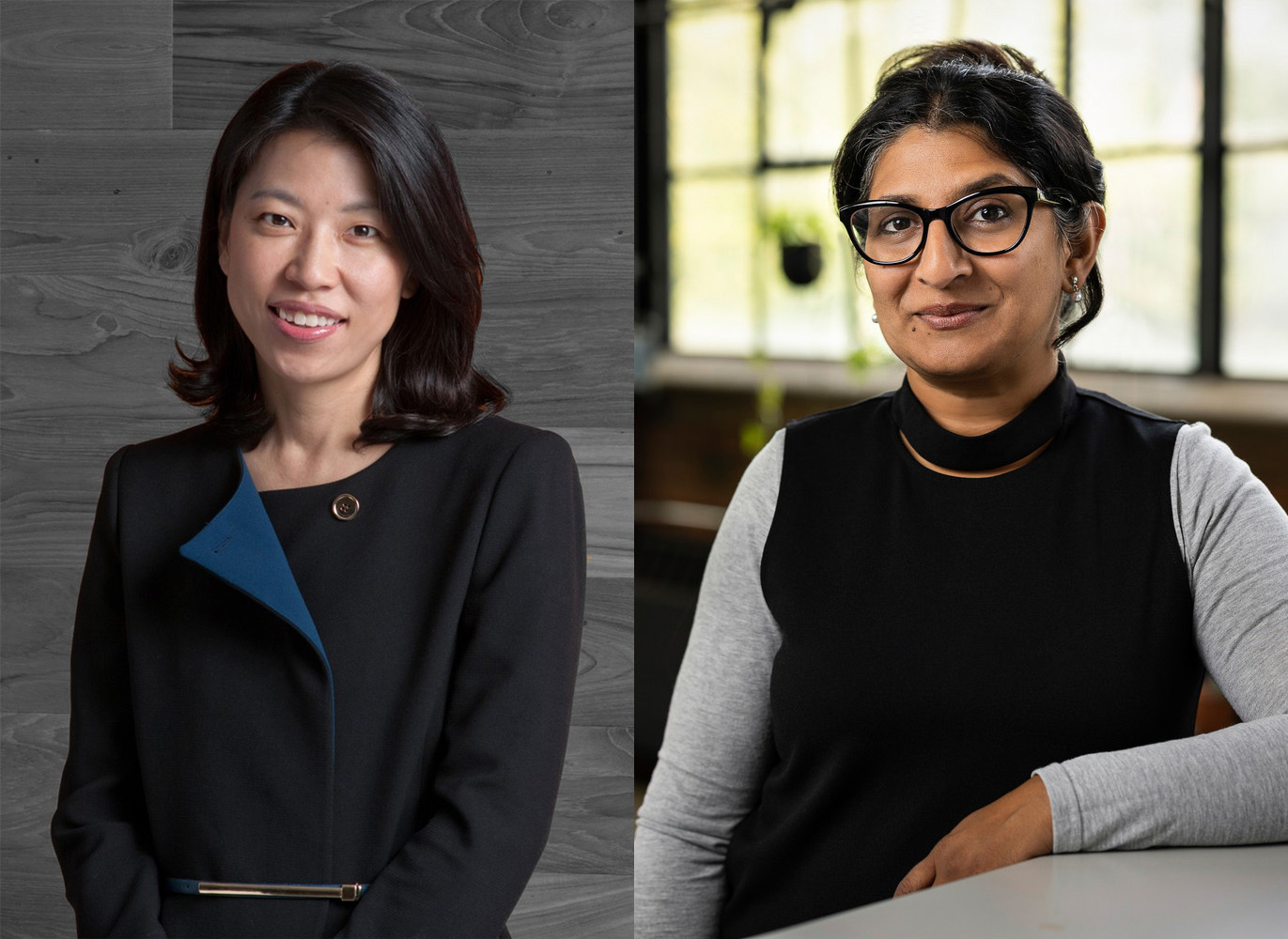
Editor’s Note: Yong In is a professor of interior design at Purdue University and has more than 25 years of experience in the design and architecture industry. She earned her master’s degree from Northwestern University and holds dual Bachelor’s degrees in interior architecture and science. She is a whole-brain designer with a unique background in both creative explorations (design/art/architecture) and analytical processes (science/engineering/strategy).