
Alanna Carter has watched her sons’ world shrink.
“I have two boys, a 23-year-old and a 19-year-old. My 23-year-old sits on the spectrum of neurodiversity, and my 19-year-old is disabled,” said Carter, Assoc. AIA, Global Healthcare Leader and Principal at Gensler, during a panel discussion at the Healthcare Design Conference + Expo earlier last week in New Orleans.
“I have observed, as they’ve grown from children into adults, their world gets smaller. And it gets smaller because of us as designers,” she said.
There is a growing emphasis on neuroinclusive and sensory-informed design in the industry, but there’s still a long way to go. The panel discussion, produced by IIDA and sponsored by Rockfon, zeroed in on the importance of designing spaces and products that support every end user — and every kind of mind.
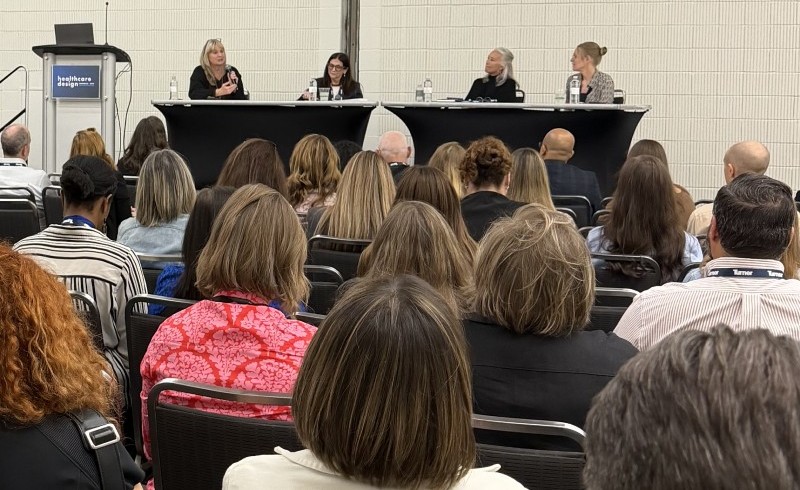
Carter wasn’t the only speaker on the panel with a personal connection to this mission. Moderator Jane Rohde, FIIDA, AIA, Principal and Founder of JSR Associates, Inc., is the primary caregiver for her two elderly parents, both of whom have dementia.
“It’s taught me that all I knew in all of the 35 years of experience that I had…taking care of your parents is a whole new story,” Rohde said.
Their experiences point to something easy to say and harder to practice: Design is ultimately about people. In healthcare, where projects are shaped by codes, clinical workflows and budgets, it’s surprisingly easy to lose sight of the humans who will move through a space. As Rohde put it, “Often in healthcare, we think about diagnosis, we don’t think about demographic.”
That distinction matters more every year. Driven in large part by an aging U.S. population, healthcare construction spending is projected to grow 4.4% in 2027, according to the American Institute of Architects, and more patients will be navigating hearing loss, cognitive decline, sensory sensitivities, or limited mobility, often several at once. For designers and manufacturers, the panel’s advice was refreshingly low-tech: Get closer to the people.
Whenever possible, designers should immerse themselves in the lives of the population they’re serving. Panelists spoke to the value of dementia workshops that mimic what it feels like to lose your senses. Rohde recalled a friend who went through a heightened version of one such training. Outfitted with devices that diminished her hearing (hearing loss is prevalent among people with dementia), Rohde’s friend then learned she’d be spending a night in a double room in a nursing home’s dementia wing. “Talk about eye-opening,” Rohde said.
If that kind of immersion isn’t feasible, there are usually three ways to research a patient population, said Amy Corneliussen Sickeler, IIDA, RID, Principal, Health, at Perkins&Will in Atlanta: direct dialogue, written surveys and silent observation. “If you get approval to silently observe an activity,” she said, “you’ll learn a lot.” The same holds true for product development teams; a few hours watching how people use (or don’t use) furnishings or storage just might reveal more than any focus group.
Understanding how people use a space shows designers what users need, how to give them more choices, and how to make sure they notice the choices they already have.
“The thing I hear often with clients after we’ve built a building and given choice is that the patients don’t actually know the choice is there,” Carter said.
Amy Mays, IIDA, Health Director, Interiors, at HDR, agreed. “We just did a project where we created quiet rooms,” she said. When her firm returned for the second phase of the project, staff reported that the rooms weren’t being used. Mays and her team are digging into why, and how to help staff and volunteers educate patients and families on the resources available.
It’s a lesson for manufacturers, too. A lighting control that’s hard to read or an adjustable chair that doesn’t look adjustable will go unused, however well it’s engineered.
Earlier in her career, Rohde said, she followed geriatric nursing assistants around to understand their routines, because spaces often get designed in ways that don’t support caregivers (and poor layouts can affect patients, too). “As a result, I’ve been in communities and hospitals where the storage area is so far away from where the procedure has to take place that a person who needs a catheter change is waiting for hours,” she said.
Design is a process of discovery, and that includes discovering the stories of the people who work in a space. Upali Nanda, Assoc. AIA, Global Sector Director of Innovation and a Partner at HKS, made a similar point on an IIDA panel at NeoCon in 2024. “Hospital designs are very predictive, they’re very planned…It’s prescriptive,” she said. “We decided when we were doing this design that it might be interesting to find out the story of the nurse.”
Staff had already told the HKS team they needed more space. But after shadowing nurses for two days, the team discovered what became known as the “applesauce moment.”
“We realized in a single event of giving one medication, one nurse could walk 1.2 miles,” Nanda said. “One medication.” A patient would take the medicine and throw up. The nurse would clean the patient up, then trek to one part of the hospital for clean clothes and another for ice chips, then finally walk another half mile for applesauce to help the medication go down.
“No one had made the connection that it might be really interesting to have the meds, and the applesauce, and the supplies together,” Nanda said. “It became the ‘applesauce moment’ for the client because they were like, ‘Huh, that’s easy.’ One tiny product that needs to be in the right place. We would’ve never had that applesauce moment if we hadn’t discovered that story and lived the experience of the humans that we were designing for.”
Carter urged designers to “keep getting deeper, keep researching, talk more.” Somewhere in every project, there’s an applesauce moment — or an opportunity to enrich someone’s experience of the built environment — waiting to be found. Designers just have to go looking for it.