
I have not stopped feeling it. That is the first thing to say about the David Geffen Galleries, Peter Zumthor’s addition to LACMA, which I visited in June and have been carrying around ever since. The first sensation is surface. The second is shadow and light. The third is motion.
The building has been judged at four levels, and each has weighed on it. As architecture, it has been measured against a rendering and a budget, and found bold, compromised or both. As urban planning, it replaced four buildings with a ribbon of concrete that crosses Wilshire Boulevard and lifts the galleries 30 feet off the ground. As curation, it has been praised for flattening hierarchies and faulted for leaving visitors unsure where they are in art history. As interior, its rooms have been called caves, its concrete hard on the body, its sound too loud.
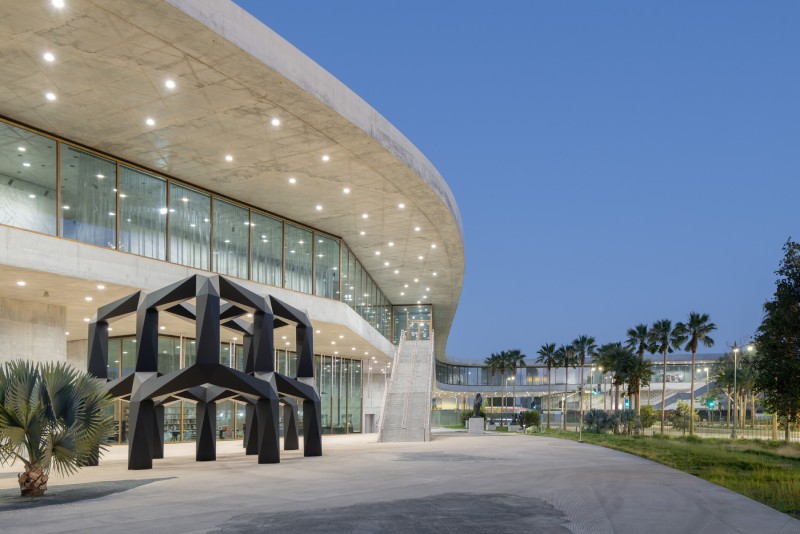
Each of those treats the building as an object in space, and each asks you to think. I’m after something else: the space in the object. Not the four levels but the interstitial place between them, where a visitor stops thinking and starts to feel. The gap between one room and the next. The veil between inside and outside. The street running beneath your feet. Zumthor writes about atmosphere, the impression a room makes on the body before the mind has a word for it, and he shares the principles of Juhani Pallasmaa, whose “The Eyes of the Skin” argues that architecture has been judged by the eye alone for far too long — an ocularcentric approach that dominates our culture at large. For me the in-between is where architecture is actually embodied.
This is not a column of praise. I’m writing about the difference between describing a building and standing in one. Between observation and embrace.
Begin with a wall. Inside, the grey concrete has the nap of velvet. It was cool, not cold, in the early summer Los Angeles sun, and pictures hung from it as if the wall had agreed to hold them. I did what everyone does. I reached out and touched it, to confirm that it really was poured concrete. I had felt that same softness at Zumthor’s Kolumba museum in Cologne, and the repetition matters: A finish can be an accident of budget, but a sensation that survives from one building to another on a different continent, is closer to a signature.
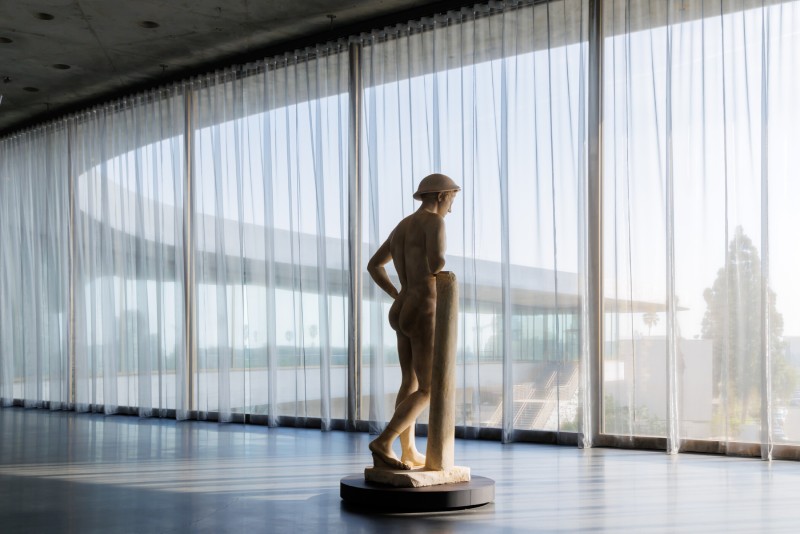
Edward Woodill, creative strategist, interior designer and die-hard Angeleno, put it simply: “The walls, stained in deep colors, have the appearance of velvet. You can’t help but reach out and touch them to confirm that they really are poured concrete.”
Then you move, and the building stops being a wall and becomes a walk. On paper, the plan scatters rooms across the floor and ties them together with irregular corridors. One critic called it a tangle. Another pointed out that a narrative may be non-linear, but the body still moves from one place to the next. Both are right about the plan. Yet neither describes the walking — or voyaging, drifting, pulled haptically through the volume by movement, color and objects. What I remember are visual connections from space to space, glimpses that drew me on before I knew I had decided to go.
Woodill felt the same pull: “The building encourages wandering rather than destination. Pace varies, curiosity increases and slows, and your internal compass spins.”
Orientation begins to disappear, Woodill said, and being lost is not inherently bad; Zumthor may want a certain amount of it. What surprised him was that the deeper he moved into the building, the more intimate it became. And I can’t forget facing a wall of flaxen-hued Roman antiquities only to turn slightly and see Francis Bacon’s “Three Studies of Lucian Freud,” roughly 60 feet ahead of me, in its figuratively abstract golden splendor.
The idea that makes this wandering legible has a name: LACMA’s Naima Keith. The vice president of education and public programs, describes the museum’s approach as “oceans, not borders.” Objects are grouped not by nation but by watery geography: the Pacific, the Atlantic, the Indian Ocean and the Mediterranean, meant to run together, physically and culturally, the way bodies of water do. LACMA said the aim is to let the works speak for themselves and let visitors invent their own story, one of migration and interconnectedness.
One does not need to be told any of this to feel it. The galleries sit on a single level, one plane with nothing above or below anything else, and that is something the body registers no matter whether the wall text explains it. Whether the idea is literal or only implied in a visitor’s comprehension, it arrives as a current. One critic describes being drawn from object to object by color, silhouette and material, allowing visitors agency versus direction. That’s the eye’s version of the idea. The body’s version is wandering on a pathless, non-hierarchical odyssey.
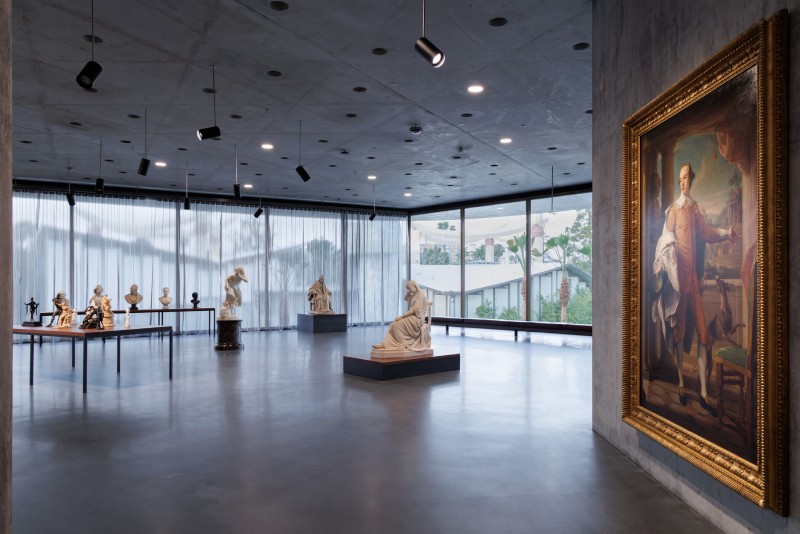
The second sensation is light, and it arrives through fabric. The glass along the edge of the building is wrapped in curtains of organza and chrome designed by the Japanese textile artist Reiko Sudo. They are silvery and translucent, and they move fluidly, swaying with the air from the building’s systems and with the people passing through. They reflect the inside and relate it to the outside. You are neither fully enclosed nor fully exposed. This, more than any room, is the interstitial: a boundary with a pulse. And shadow is a constant presence, a gentle apparition that envelops you as you move through passages and across thresholds, away from the illuminated edge. Shadow and curtain work in dialogue, creating a soft impressionistic haze.
The third is motion, and it comes from beyond the glass. The building crosses Wilshire Boulevard, so the street is not beside you but beneath you. Through that veil, automobiles pass, throwing back light and sound. A rush, a rumble, the movement below reflective of the moving cityscape providing an echo. The drapery moves as the visitors move and as the traffic moves, so that spaces seem to breathe with the city. I came to think of it as kinetically haptic: not something to look at but something that touches back. The pulse of LA.
Intimacy is the hard part. A building roughly 900 feet long has every reason to feel like an institution. Most architecture at this scale does. Creating closeness beyond a certain size is what separates the ordinary from the sublime, and it is rare. Woodill found an appropriate verb to describe this: “Zumthor doesn’t defeat the scale of the building; he interrupts it.”
“Interrupts” is exactly right. The building does not shrink. It breaks its own length with rooms, thresholds and edges, each of which you meet at the size of a body. While interior galleries stained in magenta and blue-violet provided that closeness for me, sitting on a bench at the edge above Wilshire did not.

“Ghosts” is perhaps an inaccurate word, but I will propose it. In July I wrote about Chicago and a mechanism I kept meeting there: memory or anticipation dense enough to leave something behind that a body can still register. Not superstition, residue. Derrida argued that the present is never self-contained, that it is haunted by what is gone and by futures that never arrived. I didn’t expect to find exactly the same mechanism in Los Angeles, a city with a reputation for never looking back. The site is full of it.
The galleries replace four buildings, three of them from 1965 by William Pereira, torn down in 2020. The La Brea Tar Pits lie next door, and the ground proved difficult enough that the budget carried a contingency for tar and fossils. The objects inside carry residue of their own, each having arrived from somewhere else, which is what “oceans, not borders” implies. None of this is visible from inside. All of it, I believe, is felt.
Edward Woodill saw the other half of it: “Zumthor has placed a repository of objects preserved against time in the middle of a city that refuses to stop.”
Outside, Los Angeles demolishes, rebuilds, reinvents and moves on, and the cars passing under the galleries are that habit in motion. Ghosts live in the in-between, and the drapery is where I felt it most: a veil standing between preservation and motion, with the cinematic flicker of the city seen through it. What I sensed there was residue of a different kind: not what Los Angeles remembers, but what it leaves behind as it goes.
I should be honest about what I know. I have been once, at one part of the day, and Zumthor’s work depends on the time of day more than most. Woodill has been three times, between late morning and late afternoon, and a building so tied to light cannot be known from a single visit. Nor do I claim that the galleries succeed everywhere. Scale is a hard master, and some visitors will find the whole too long, too grey, too much.
What I assert is narrower. Architecture, urban planning, curation and interior design have each delivered a verdict, and each may be right on its own terms. But they measure something Zumthor never promised. What he promises, in every building, is that you will feel it. In June, with my hand on a velvet wall and the city moving through a veil, I did.
A recent weekend at the Chinati Foundation in Marfa gave me a measure. Donald Judd’s aluminum boxes fill two former artillery sheds, and what you find inside them is expansive, reflective space within the objects: light, shadow and reflection shifting across a day and a season, so that no visit repeats another. Ever changing, always providing fresh interpretations and transcendent visual, haptic experiences that drift and float towards the sublime. Zumthor’s galleries ask for the same patience. I would like to see them again, at another hour, in another light.
Through exploration during the past few months and my research, it became apparent that my previous article, and this one, will coalesce with the next to form a kind of trilogy. After I moderated a panel in New York City for the IIDA, its topic revealed yet another place to explore: beauty, belonging and memory.
As Edward Woodill sees it, Zumthor did not stop Los Angeles; he framed it. I would add only that a frame is also what a ghost needs, something to stand in while the present moves on. Residue waits for whoever walks through next.