
Four days into the job, Irene Tasi already sounds like someone who has been at Steelcase far longer. She held her first town hall with employees last week, the day before the interview for this story, and she’s been getting stopped in the hallways and cafeteria ever since, which, she said, is exactly the way she wants it.
She also has a lot of work to do. Tasi said she intends to focus initially on marketing, product development and commercial strategies — areas where Steelcase has a long history of strength — while looking for opportunities to improve them. She also sees the HNI acquisition as an opportunity to add capabilities and scale without eroding what makes Steelcase different.
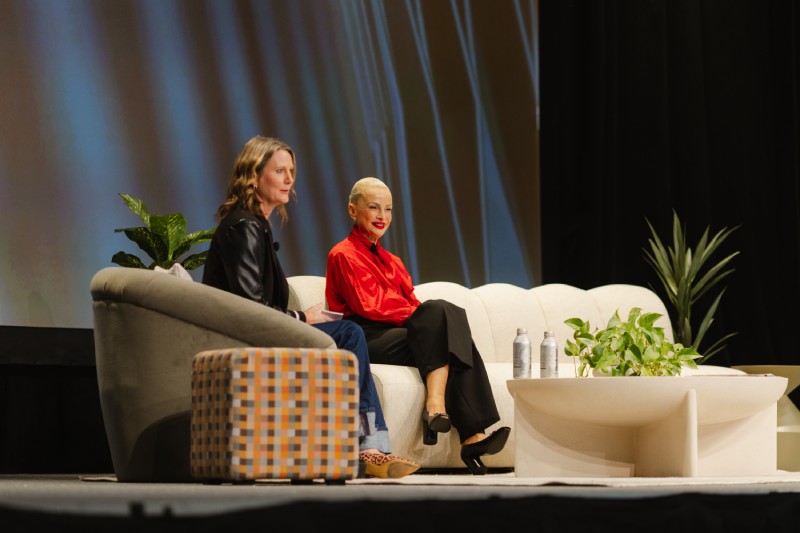
All of it begins with a listening tour, which has already produced a travel itinerary. Tasi spent her first two days on the job meeting with some of Steelcase’s top dealers, and soon she’ll be in Palm Springs for the company’s annual dealer conference. After that, she said, she’s “hitting the road” to visit as many dealers as she can before year’s end. That includes a trip this week for mock up presentations for the Henry Ford Hospital expansion in Detroit, one of the largest and most important furniture projects coming online in Michigan and a site visit dealers specifically asked her to make.
The dealer relationship carries extra weight given how the last major industry consolidation played out. She gets the importance of the relationship between the company and its dealers. Tasi called Steelcase dealers one of the company’s deepest assets: “Steelcase has one of the strongest dealer networks in the industry. And this is a dealer network that has been nourished and cultivated over (more than 100 years),” she said.
On the HNI integration itself, Tasi described a deliberate, selective approach rather than a wholesale merger. “We’ve got a lot of integration work that we are doing obviously with the acquisition, but that’s actually going very, very well. And the company has been very intentional about where we are going to integrate to realize some great value,” she said, pointing to things like shared scale on raw-material purchasing as an easy, low-risk win. But, she added, “They’ve also been very, very clear that they understand Steelcase’s very unique positioning in the market and we want to make sure that we’re insulating that and we’re doing nothing but strengthening that moving forward.”
That same logic extends to research, long a hallmark of Steelcase’s product development. Tasi said HNI has been clear that Steelcase’s market position differs from its other brands, meaning the research-driven model that has defined Steelcase’s product roadmap isn’t going away; if anything, she said the question is whether the company needs more of it, including new research into how AI is reshaping the workplace.
Internally, Tasi acknowledged the anxiety that inevitably accompanies any acquisition. Her prescription is clarity, delivered early and often: “I think that we just have to keep pressuring ourselves to make sure that we are being very clear, not only internally, but also externally in terms of this is what we will do and this is what we are not going to do and what you can expect from us going forward.”
Preserving Steelcase’s famously familial culture, including generations of employees who have worked the factory floor and at its Grand Rapids headquarters, is clearly personal to her. “I have gone into the cafeteria, bumped into people,” she said. “I really want to know about people’s families and want to be a part of the community.”
This isn’t Tasi’s first exposure to Steelcase’s culture. More than 20 years ago, as a young marketer at Masco, she visited Steelcase to benchmark “human centered design” and was introduced to a then-unfamiliar term — ethnographic research. It left a huge impression on her and is part of the reason she took the job.
Asked how colleagues would describe her leadership style, Tasi didn’t hesitate: “I have a lot of energy. I actually get my energy from interacting with people. I love collaborative type of environments where we can play off of each other’s ideas…I want to make people feel safe so that we can execute together, but at the same time, I have a very high sense of accountability.”
It is an accurate self description. She is energetic and engaging; at times funny, but serious about the future of Steelcase and her expectations of her team. She answers questions directly and does not skirt around difficult topics.
On the fear of layoffs that often accompanies consolidation, Tasi was direct about why HNI chose her. “HNI bought Steelcase to grow the business. That is the number one,” she said. “They didn’t want someone that was a restructuring expert to come in…they were very intentional about wanting someone that comes from a more-commercial background because they want to grow this business.”
She’s betting heavily and believes in the importance of the office. “I think everyone’s realizing how important it is for humans to be together. I think that’s a huge opportunity for us,” said Tasi.
She’s similarly unbothered by AI anxiety. “If you look at it on the surface, people might think…there’s not going to be as many people doing things anymore because AI is going to take over the world,” she said. “But the way that I see it is…what AI is going to do is a lot of these repetitive tasks. But then we will need a lot of human judgment, a lot of human creativity.”
Tasi brings a decidedly varied background to the job. She studied international relations at the University of Windsor and began her career working in government on housing policy. An unexpected assignment implementing an ERP system introduced her to business processes, technology and change management.
She later joined Masco, where she worked across multiple business units and functions, including shared services, strategy and investor relations. At Masco Cabinetry, she moved into marketing and eventually led sales, giving her experience with architects, designers, independent dealers and contractors.
She then led Kichler Lighting through its integration into Masco after the acquisition of the family-run company. That experience gave her firsthand knowledge of integrating a longstanding brand and a multigenerational dealer network into a large public company.
After 21 years at Masco, Tasi moved to PPG, taking a newly created C-suite role focused on growth. The move expanded her experience into B2B businesses and a global organization operating in more than 70 countries.
But she said she missed being in a branded, design-led category. That made the Steelcase opportunity particularly compelling. After a long career at Masco, she hopes for the same at Steelcase. This isn’t a touch-and-go in her career climbing the corporate ladder.
“I recognize the honor and the privilege of what it means to be able to lead this company and especially at the point that it is now,” she said. “I do not take it lightly in any way, and I recognize what I have walked into, which is an incredible culture, an incredible legacy, incredible partners with our customers.”